
The Rhythm Revolution: How Boutique Spin Studios are Redefining the Fitness Industry
The fitness landscape has fundamentally shifted. The days of solitary workouts under glaring fluorescent gym lights, staring blankly at a television screen while pedaling a stationary bike to nowhere, are rapidly becoming a relic of the past. In their place, a cultural phenomenon has taken root, transforming the simple act of indoor cycling into an immersive, emotionally charged, full-body experience.
Today, boutique spin studios in major hubs from Vancouver to Toronto—and across the globe—are no longer just places to burn calories. They are sanctuaries. They are nightclubs infused with endorphins. Most importantly, they are fiercely loyal communities driven by the heavy drop of a bassline and the guiding voice of an instructor who acts as part coach, part DJ, and part spiritual leader.
As the indoor cycling industry continues its explosive evolution in 2026, the division between traditional metric-based cycling and rhythm-based cycling has never been clearer. Here is a deep dive into the current state of the spin class industry, the rise of the rhythm movement, and what the future holds for studios, riders, and the instructors who lead them.
Johnny zakharia vancouver
The Genesis: From Off-Season Training to a Cultural Phenomenon
To understand where indoor cycling is going, we must look at where it began. In the late 1980s and 1990s, indoor cycling was pioneered as a gritty, utilitarian method for outdoor cyclists to maintain their endurance during the off-season. The methodology was rigid: heavy resistance, strict metric tracking (watts, distance, and RPMs), and a relentless focus on simulating outdoor terrain like steep hills and strong headwinds. Music was merely an afterthought—background noise intended to drown out the mechanical whir of heavy flywheels.
The paradigm shifted when fitness innovators realized that the broader population wasn’t training for the Tour de France; they were looking for a psychological release. They wanted an escape from the relentless grind of daily life.
By borrowing elements from group dance and aerobics, the industry pivoted. The BPM (Beats Per Minute) of the music replaced the digital wattage readout as the focal point of the ride. Today, rhythm spin is the dominant force in the boutique fitness market because it prioritizes mental release, musical connection, and community over sheer data output.
The Anatomy of a Modern Rhythm Ride
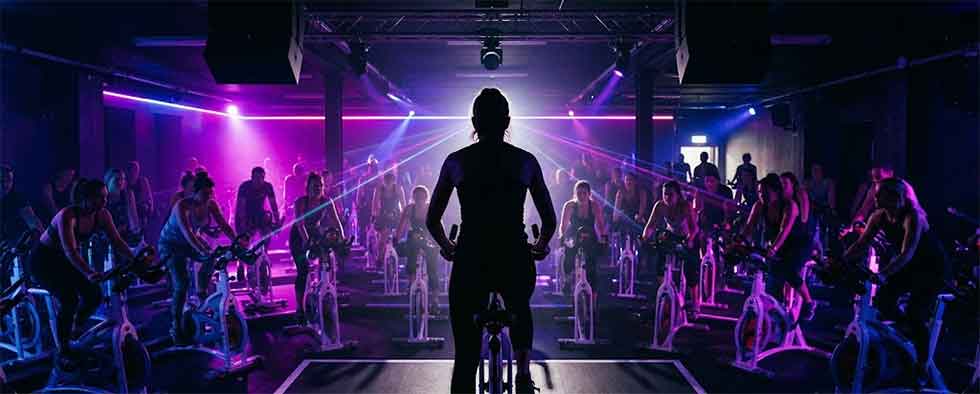
Walk into a modern rhythm cycling class, and you will immediately notice the difference. The digital monitors are often removed entirely or hidden from view. The room is pitch black, illuminated only by synchronized LED lighting that pulses to the beat of a curated EDM, hip-hop, or pop remix playlist.
In rhythm cycling, the music is not in the background; it is the track you ride on. The fundamental building blocks of this experience are the Downbeat and the 32-Count Phrase.
Every pedal stroke is dictated by the tempo. When the heavy bass drops on the “1-count,” forty pairs of legs strike the bottom of the pedal stroke simultaneously. This creates a mesmerizing wave of unified movement. Instructors map their playlists meticulously, understanding that commercial music is mathematically structured. They don’t just ask riders to sprint randomly; they build anticipation through the verse, tease the drop during the bridge, and demand a breathless, maximum-effort sprint the exact millisecond the chorus explodes.
This precision is where the magic happens. When physical exertion syncs perfectly with musical phrasing, riders enter a psychological “flow state.” The workout ceases to be a grueling physical chore and becomes a moving meditation. The pain of a heavy, 65-BPM standing climb transforms into a feeling of collective triumph.
john zakharia vancouver
Choreography: The Bike as an Instrument
The most visually striking evolution in modern spin studios is the introduction of upper-body choreography. In traditional cycling, the upper body remains static. In rhythm cycling, the bike becomes an instrument of expression.
Industry-leading studios are pushing the boundaries of what is possible on a stationary bike, incorporating dynamic movements that challenge core stability, coordination, and muscular endurance.
* **Tap-Backs:** Riders shift their hips dynamically back over the saddle on the beat, targeting the glutes, hamstrings, and transverse abdominis while keeping their hands light on the handlebars.
* **Handlebar Presses:** Executed with a strict, neutral spine, riders hinge from the elbows to bring their chest toward the console, engaging the triceps and pectorals without losing the rhythm of their legs.
* **The “4 Corners”:** Advanced choreography where riders shift their upper body in a figure-eight motion, utilizing their obliques to drive their weight into each corner of the bike while holding a heavy, out-of-the-saddle jog.
* **Isolations:** The ultimate test of strength, where the upper body is completely frozen, and the legs must push through immense magnetic resistance without the aid of upper-body momentum.
The crucial caveat to this evolution—and a major focus for industry regulators and premium certification programs—is biomechanical safety. Flashy social media trends have occasionally led to high-risk maneuvers, such as sprinting at 120 RPM while holding dumbbells. The current standard of excellence in the industry loudly champions safety over spectacle: rhythm and choreography must *never* supersede proper form. If the hips are bouncing, the resistance is too low, and the choreography must stop until the foundation is secure.
The Hardware Arms Race
As the methodology of indoor cycling has evolved, so has the studio hardware. The industry is currently dominated by a “Core Four” of manufacturers, each racing to provide the smoothest, most responsive ride to support the demands of rhythm choreography.
* **Technogym:** Rapidly taking over high-end boutique spaces, these Italian-designed bikes feature sleek aesthetics, pinpoint-accurate magnetic resistance, and tactile clicks on the resistance dial, allowing riders to feel exactly how much tension they are adding in the dark.
* **Stages Indoor Cycling:** Beloved for their authentic road feel and carbon fiber belt drives, these bikes often feature a “SprintShift” lever, allowing rhythm riders to instantly dump or add heavy resistance for quick choreographic transitions.
* **Keiser (M3i):** Famous for their rear-flywheel design (which protects the mechanics from sweat in hot, packed rooms) and a magnetic lever system mapped precisely to gears 1 through 24.
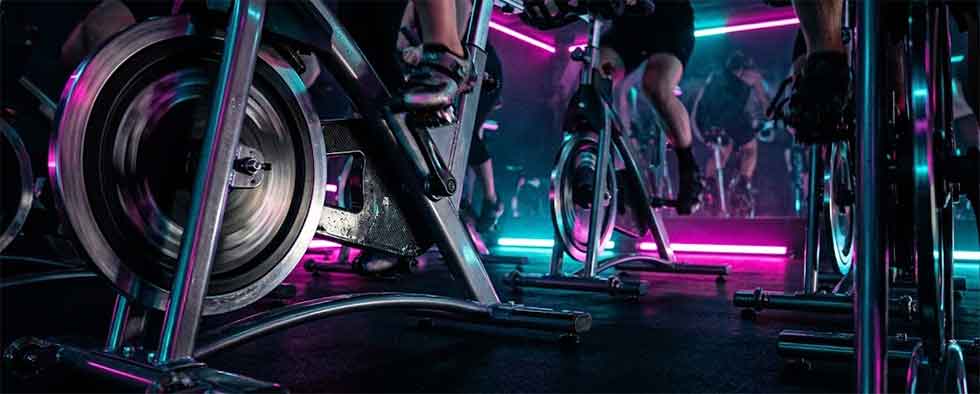
* **Schwinn (AC Performance):** The durable, reliable workhorse of the industry, utilizing a heavy perimeter-weighted flywheel that generates massive inertia, requiring a powerful, engaged pedal stroke.
Studio owners are investing heavily in these premium machines because a clunky, uneven pedal stroke instantly shatters the illusion of the rhythm experience.
The Instructor: Community Leader and Brand Architect
The success of a modern spin studio rests entirely on the shoulders of its instructors. Beautiful lighting and top-tier bikes are useless without a leader who can command the room.
The role of the indoor cycling instructor has evolved into a highly specialized profession requiring a unique blend of skills. They must possess the physiological knowledge of a personal trainer, understanding aerobic versus anaerobic energy systems and biomechanical alignment. They must have the ear of a club DJ, capable of mapping 32-count phrases and blending tempos seamlessly. And they must possess the emotional intelligence of a motivational speaker, knowing exactly when to push the room to its breaking point and when to offer grace.
Elite instructors understand that their voice is their most powerful tool. They master the “Rule of Three” in their vocal cueing: giving a clear direction, allowing the room to process it, and then embracing the silence so the music can do the heavy lifting. They do not yell over the track; they ride within it.
Furthermore, today’s instructors are individual brands. They cultivate highly engaged followings on platforms like Instagram and TikTok, sharing choreography breakdowns, playlist inspirations, and fitness philosophy. Riders will regularly travel across cities, following their favorite instructors from studio to studio, proving that in the boutique fitness world, loyalty is tied to the human connection, not the brick-and-mortar building.
What’s Next for the Spin Industry?
As we look toward the end of the decade, the indoor cycling industry is poised for further refinement rather than reinvention. The market has matured. Riders are smarter, more discerning, and less tolerant of poor instruction or unsafe mechanics.
The future belongs to education. Studios are recognizing that in-house training is often not enough to produce world-class talent. There is a massive, growing demand for standardized, high-level education that bridges the gap between raw charisma and technical mastery. The industry needs instructors who understand that a ride is a carefully constructed emotional narrative—an arc that moves from arrival, to connection, to challenge, to climax, and finally, to celebration.
For those passionate about fitness, music, and community, there has never been a better time to step onto the podium. The world doesn’t need another generic workout; it needs leaders who can turn a dark room into a transformative experience.
Ready to turn your passion for the bike into a thriving profession?
The Indoor Cycling Society is dedicated to raising the standard of rhythm riding worldwide. Whether you are aiming to land your first studio audition or looking to refine your advanced choreography and musical mapping, we have the blueprint.
Our **Master Rhythm Cycling Instructor Course** is a comprehensive, professional certification program that teaches you the exact exercise science, biomechanics, and performance skills needed to become an elite rhythm instructor.
For a limited time, you can get fully certified for only **$97**.
Don’t just ride to the beat—learn how to command the room. Visit www.indoorcycling.ca/certification to enroll and start your journey today.